

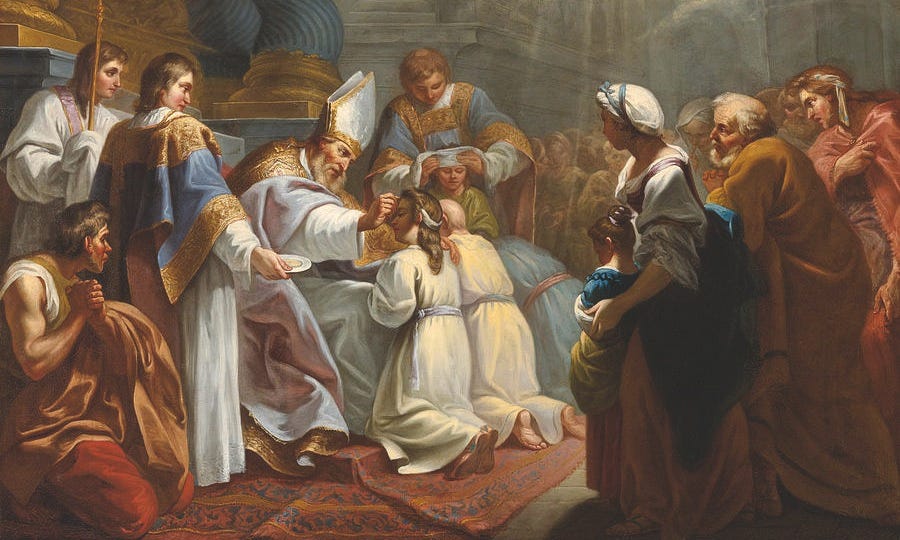
Now when the apostles in Jerusalem heard that Samaria had accepted the word of God, they sent them Peter and John, who went down and prayed for them, that they might receive the Holy Spirit, for it had not yet fallen upon any of them; they had only been baptized in the name of the Lord Jesus. Then they laid hands on them and they received the Holy Spirit (Acts 8:14-17).
We are nearing the end of the Easter Season. Next week we will celebrate the Feast of the Ascension of the Lord and the week after that we will celebrate Pentecost and the descent of the Holy Spirit upon the Church. The gospel that we hear today points us to these coming events. Jesus tells his disciples that in a little while they will no longer see him, but he will not leave us orphans. He will send an Advocate, the Holy Spirit, to be with us always, and through the Holy Spirit we will be in Jesus, just as Jesus is in the Father.
We will abide in him, and he in us, just as he abides in the Father and the Father in him. And this union with Christ and the Father is made possible through the Holy Spirit. The Spirit is like the glue that binds us to the Trinity. He makes our union with the Father and the Son possible. So how do we participate in this life of the Spirit?
If you pay attention to the readings we hear at Mass during the Easter season, you might notice how often they point us to the sacraments as a source of grace. It is as though Jesus is telling us, this is how I will be with you. This is how you are to remain in me and I in you. We participate in the life of the Spirit through the sacraments Christ left us.
On the very day of the resurrection Jesus breathed on the Apostles and said, “Receive the Holy Spirit. Whose sins you forgive are forgiven them” — the sacrament of Reconciliation. On that same day, Jesus accompanies two disciples on the road to Emmaus, where he makes his presence known to them in the breaking of the bread — the Eucharist. Last Sunday we heard about the sacrament of holy orders, when the first deacons were ordained through the laying on of hands as assistants to the Apostles to share in their ministry; men filled with the Holy Spirit. Today we hear about one of those deacons, Philip, baptizing people in Samaria. But there was a limit to what Philip, as a deacon, could do. He could baptize them, but he could not lay hands on them and call down the Holy Spirit — what we today call the sacrament of confirmation. For that, you need the authority of a bishop. And so they sent for the Apostles, Peter and John, who administered that sacrament and so completed the Samaritan Christians’ initiation into the Church.
Why was this confirmation necessary? If baptism is our participation in the death and resurrection of Jesus, confirmation is our participation in Pentecost. It is when the Holy Spirit empowers us as he empowered the Apostles, enabling them to proclaim the gospel, both in word and by the example of their lives, boldly withstanding persecution. That is our job as Christians, but we can’t do it effectively by our own power. We need the power of the Spirit.
But don’t we receive the Holy Spirit at baptism? Yes, we do. So what makes confirmation unique? So many of us in the Church struggle to give an answer to that question. Confirmation has been called “a sacrament in search of a theology.” And this is a shame, because as we see in today’s readings, it goes all the way back to the very beginning of the Church. The Apostles came to these new converts who had been baptized, and so were now part of the Church; but they needed something more. They needed to be confirmed as members of the Body of Christ by receiving the Spirit that animates that Body.
I think perhaps our understanding of confirmation is lacking because we don’t understand the natural symbol being evoked. All of the sacraments convey God’s supernatural grace to us through natural symbols that we can understand. Jesus feeds us with his Body and Blood in the Eucharist, and we understand this through the natural symbols of bread and wine. In baptism we die to our old self and rise a new creation in Christ, which is shown by the symbol of descending into the waters and rising again from them. Baptism is also a cleansing. It cleanses us of sin as an ordinary bath cleanses us from dirt.
The natural symbol helps us to understand what is taking place spiritually, that is hidden to our senses. So what is the natural symbol for confirmation? We are anointed with oil. That is the physical sign. Today most of us are only anointed with oil in church, so we don’t have a context for its meaning as a natural symbol. But the truth is, we do anoint ourselves all the time, we just don’t use that language to describe it.
After we bathe, what do many of us do? We may moisturize our skin with lotion, or put on cologne or perfume. These are forms of anointing. They are not necessary parts of bathing. Soap and water will get us clean. Lotions and perfumes are extra; they are an added luxury, making our skin soft and making us smell good. It’s a way of pampering ourselves. Ancient people liked to feel good and smell good just like us, only their way of doing it was to use scented oil. They would anoint themselves in this way.
Because this anointing was an added luxury, it came to be used in ancient Israel as a sign of God’s special favor. When God chose Aaron as high priest, for example, Moses anointed him with oil. When God chose David as king, Samuel anointed him with oil. These anointings signified that God was bestowing special blessings upon these individuals, not just because God liked them, but because God was preparing them for an important mission; to be a priest or to be a king. They would face special challenges and so needed additional strength from God to carry out their mission.
In Hebrew, the word for an anointed person is messiah. In Greek it is christos. We call Jesus the Christ because he is anointed by God in a special, unique way. When did Jesus receive his anointing? It was immediately after his baptism, when the Holy Spirit descended upon him in the form of a dove. Jesus was not anointed with a symbol of the Spirit. He was anointed by the Spirit directly, as were the Apostles at Pentecost.
So confirmation and baptism have always been linked together in the mind of the Church. We are made members of Christ through baptism, and that means we also share in his mission. That means we also need a share in his anointing. This is what it means to be a Christian; the word “Christian” literally means a “little anointed one,” a “little Christ.” That’s why the Samaritan Christians, even though Philip had baptized them, still needed anointing by the Holy Spirit, to strengthen them for their mission — their part in Jesus’ mission.
Jesus’ mission is the reconciliation of mankind to God the Father by forgiving sins, conquering death, and raising us to eternal life. Our part in that mission is to live in light of that reality and to proclaim that good news to all the world; to give a reason for our hope, as St. Peter says in the second reading. We are called to be priests and kings and apostles of Jesus Christ, and God empowers us for this mission through anointing; through confirmation. Everyone in this church who has been confirmed has this anointing, this power, and this mission. What we do not have is excuses. Whatever excuses we might think we have, the Holy Spirit is telling us, “I have taken care of that already. Trust me to lead you and give you strength.”
Jesus calls the Holy Spirit the Paraclete. That’s not a type of bird. It’s a legal term which means “advocate.” What it literally means in Greek is “someone who walks beside us.” The Spirit walks beside us even now. When we read of the Apostles performing mighty deeds in the early Church — curing the sick, casting out demons, dying for the faith — we need to remember that we are part of the same Church and that we have received the same Spirit.
So in these days leading up to Pentecost, let us, like the Apostles, devote ourselves to prayer and open our hearts and minds to everything that the Spirit makes possible for us. Let us not just be passive recipients of grace, but let’s live our mission as Apostles in the 21st century, proclaiming good news, giving reason for our hope with gentleness, reverence, and the power of the Spirit, to all who very much need a reason for hope.